Showing posts with label film. Show all posts

15 June 2013

At the Movies

Last night I got to accompany Father Robert Barron to the movies along with some friends here in the seminary community. Given the hubbub surrounding Christopher Nolan's latest film Man of Steel, our choice was obvious.

Unfortunately, there wasn't much to enjoy.

The trouble with superheroes is that there's nothing at stake; only so many face-grinding, body-pummeling variations on the theme of indestructible beings at war are possible. The battles stretched interminably, while we yawned. The dialogue was wooden and strained; performances from Crowe and Lane were surprisingly one-dimensional. 


In my estimation, the best part of this movie was the trailer; the brief placement of the images of power (launching from the ground, breaking the sound barrier) alongside the simplicity of farm life and boyhood were really the only matters of interest for me, the only thing that savored of real delight. The rest was so much sound and spectacle. Nolan had better get back in the driver's seat...

Save your $12 and just watch the trailer.

30 April 2011

Firebomb your Frenemies

GQ has an interview with Bavarian filmmaker Werner Herzog, director of such classics as Aguirre, the Wrath of God and Grizzly Man.
There is nothing glorious about making a film. It is an endless sequence of banalities. 
 A must read for film enthusiasts.

02 August 2010

Once Twice

The list of films that have made the cut of those worthy to be watched again is pretty short.  Of those films, I only own a handful, and several of those were gifts.  As I sit here and think about it, it’s hard to even justify watching some of those again—why watch when so many more must be sifted?

I suppose since it’s so short, it won’t be too hard to put them down here, in no particular order (though I must admit I’m leaving out the adolescent selections, as they’ve not remained with me into adulthood, and rarely stand up to a more mature scrutiny***):
  • “Master and Commander”—stepping into the lost world of the age of sail, with exquisite cinematography of battle sequences straight out of a Winslow Homer painting
  • “The Thin Red Line”—some have expressed frustration with the ponderous voice-overs, but Malick created something utterly fascinating with the cast of celebrities who fell over one another for bit parts in one of his films.  The intensity of this film is achingly, painfully beautiful.
  • “Punch Drunk Love”—the first serious acting I ever saw Adam Sandler do.  A truly funny film, alternately cross-eyed and sympathetic toward the quirky, neurotic cast.  “I have a love that makes me stronger than you can imagine. . . I would just say ‘that’s that,’ mattress man.”
  • “The Dark Knight”—just watched it again at the beginning of the summer.  While I am more inclined to side with reviewers that suggested it could’ve used some more judicious cutting, I stand by my fascination with this mythical story.
  • “The Big Lebowski”—delight in disorder.
  • “Children of Men”—I was shocked by how powerful this film was for me.
  • “Lonesome Dove”—a made-for-TV adaptation of McMurtry’s Pulitzer Prize winner.  An epic western that managed to capture the tragic side of the open range and its codes, tinged with glory.
  • “Princess Mononoke”—a Miyazaki anime feature, bizarre and outrageously imaginative, and masterful in the use of silence as the aura of the sacred.
I could go on. . . but the point is, not for much longer.

The most recent entry on this list is entitled, ironically, “Once”.  What I have to say about it won’t make much sense unless you’ve seen it, so I wouldn’t bother reading further if you haven’t—besides, you should already be making your way to your Netflix queue to get ahold of it. 

I was first turned on to this film by Barb Nicolosi’s review (back when her blog for her work with the screenwriting guild Act One was still up and running).  The soundtrack proved to be the hook for her, and so it has continued to be for me.  Piping it through my stereo last week inspired me to return to this little film, shot for cheap on the sooty, overcast streets of Dublin (though it could’ve been anywhere) . It tells the story of a busking guitarist who, meets a gal on a lonely street while cutting his chest open for everyone to see (lyrically speaking).  Her musical talents quickly become evident to him, and they mutually ignite a unique creativity that helps the guy to record a demo of his truly talented songwriting, and for both of them to get their lives back on track, discovering what they truly want and living up to the situations in which they find themselves.

What unfolds is something like a cross between a musical and a documentary on music production; you almost expect the camera to cut to a face-to-face interview with the characters who then explain what they were thinking at the time and how crazy all that was and how they pretended to like the gal’s mother-in-law but really didn’t, etc.  But of course, it never does, because these people are not being asked to step out of their subjectivity and feed it back to the viewer.  They thrive in it, steeped in the confusion and ambiguity of their attraction to one another amidst deeper and more lasting commitments to other people.  Neither is ever given a name, but these characters take on a warmth and charm that got me to root for them in a way I usually can’t when it comes to film (now novels, on the other hand. . . ). 

This was clearest for me in the sequence when the Guy decides to record a demo before leaving for London.  There is an amusing and kind of adventurous feel to the work that must be done in order to book a recording studio, including persuading a loan-officer-turned-songwriter to lend him the money to book a recording studio for a weekend.  In a spare yet rich scene, the studio engineer skeptically looks on as the unimpressive cadre of backing musicians and immigrants prepares to record their first take.  There was a rush of adrenaline as I watched them step up to lay themselves on the line.  This guy was taking a real risk—the music wasn’t just a dream anymore, pondered morosely in the upstairs room of his da’s house.  There was money on the line.  There were consequences to this performance.  And what comes forth from the various voices and instruments in that moment of risk is stirring.  In unison with the engineer, who had settled in for a long weekend of coddling some amateurs, we realize that this is something good.  They’re doing it, I said to myself.  This is a moment each of these strange people has been preparing for.  A moment of kairos, where time ceases to be a mere succession of “nows” and whirlpools into an axis of destiny—foreseen, intended, rejoiced over.  And honestly, it was beautiful to see them doing it—musicians played by real musicians, who knew the thrill of being thrown together with unfamiliar players at a moment of truth, and who could therefore create a believable now-or-never moment that drew out of me an unconsidered, unrestrained, fist-pounding burst of tears.  I said there and then, in a kind of prayer, This is real.  This is real.  This is real.  I believed every second of it, rehearsed as it was, in spite of never having experienced any of that myself . . . yes, I believed every second.  I drank it in through my eyes, thrust forward in the lazy boy, heart pounding like this was battle footage.  Watching people making music

This, my friends, is filmmaking.

In the bleary, waking unconsciousness of overwork, relationships evolve rapidly, and the film did a fine job of capturing the meandering, miscellaneous energy of creative collaboration in which the hours and days melt into one another.  But it also managed to help me see the joyful rest on the far side of it.  The Guy sits on the car hood, watching these familiar strangers goofing on the chilly beach as the sun rises, the fumes of a fresh success still swimming through him—a success that had nothing to do with recognition or payoff, but of the joy that came from being the lynchpin in the bringing into the world of something genuine, something marvelous in its exuberance and nuance.  It is in this moment that the Guy is really, truly enviable—having stepped forward into uncertainty and the possibility of failure, he was proven worthy to proceed, worthy to have led these nobodies into somebody-ness. 

They disband as quickly as they were assembled, without much explanation.  So pass our successes, recognized perhaps only by a few.  But those few matter to us.  They matter deeply.  “We cannot speak to ourselves the words we most need to hear.”  Those who speak them may be deeply attached to us, like fathers; they may be nothing more than familiar strangers with an eye to see the goodness in what we do, and the credibility to speak with authority—like the recording engineer who almost becomes a part of the band he is being paid to assist.  It is a deep mystery of human existence that we receive our flourishing not from within but from without.  It is given to us as a gift, a word of love that confirms to us beyond any doubt that it is good that we, that I, exist.

The filmmakers should be very, very proud of this film, and I encourage whoever has gone ahead and read this post without having seen the film to take advantage of the first opportunity to do so.

*** I am not and never will be ashamed of my devotion to “The Last of the Mohicans” throughout most of my teens.

19 March 2010

News To Me

The most interesting part of the New York Times’ review of “Greenberg” (opening in theaters this weekend) is the last line of the review:
“Greenberg” is rated R (Under 17 requires accompanying parent or adult guardian). Swearing, nudity, drug use, emotional violence.
The Motion Picture Society of America: Classifying Objectional Content With Specificity Since 1922.

09 October 2008

A Feather In the Cap

The furious fascination I had with The Dark Knight back in the summer has subsided, but lo and behold, another review has just been posted over at The Catholic Thing and I was much gratified to see that it coincided with my own opinions on a number of different points.

You can read the new review here.

I wish I could conjure up a nice post for you, but it's midterm week and I seem to be burning up all my time on reading about the financial crisis. Soon I'll be neck deep in a crisis of my own. In the meanwhile, I'll just keep linking to old posts in the hope that one day I'll have what the critics call an Original Thought.

24 July 2008

The Dark Knight Spawns Controversy?

If I can offer some follow-up to my original review of Dark Knight, I would suggest you read two other views that give us some point-counterpoint to ponder. If you've read what I have to say about this film, you'll find me decidedly in favor of one of these two, and quite surprised at the blindness of the other. You can find them at

http://www.nypress.com/21/29/film/ArmondWhite.cfm

and

http://www.firstthings.com/onthesquare/?p=1130

Please post your comments on the original review, if you please ...

19 July 2008

The Dark Knight Runs Because We Have To Chase Him

I’d promised a review of WALL*E about a week ago but I made the mistake of going out to see Batman this afternoon. Sorry little guy, but you just got bumped. The Dark Knight brooks no competition.

This movie provoked some incredible discussion afterwards that I’d like to put up here, but most of that will contain spoilers so it might be nice to put some preliminary thoughts down first. Let me just say that I have not enjoyed a movie like this for a long time—Children of Men was probably the last film to give me such a high as this one. The filmmakers were able to build on the foundations laid in Batman Begins, and there is no question that Heath Ledger’s portrayal of the Joker takes the character to new heights (and/or depths). What a phenomenal film to have as one’s last.

As of today, the whole Batman world has taken on a more distinguished hue. The word “epic” has been applied to the film, and I myself had the feeling that what I was viewing was at least was striving to operate on the level of something like Greek drama. About three quarters of the way through the movie, I realized why this comic book figure has fascinated us for almost a generation now: it is a modern myth. It is the same sort of myth the ancients recounted as they circled around the fire and reminisced about their godlike heroes late into the night, perhaps only dimly aware they were telling stories about themselves. It is what their poets worked and reworked, fleshing the tales out over time, embellishing them with their own narrative inclinations and truncating what did not grip the imagination or fortify the soul. Where else in our age can we find this storytelling than in our more enduring popular literature and film?

Now, I am no reader of comic books. I’m sure there are plenty of deviations in the movie from who Batman is in those original comics. Most of what I have to say will have no awareness of the prior fieldwork that has produced this fruit; I judge the film on its own terms. As long as what is presented stands in basic continuity with its prior forms, there is room for legitimate reinterpretation of this heroic figure and his attendant nemeses. There are no copyrights on myths.

READER BEWARE!

I should also note that I am chronically incapable of enjoying stories for stories’ sake. It’s like I have a compulsion to launch into abstraction without taking the time to delight much in characterization, scenery, or storytelling. This is nothing to boast about and is probably the reason why I could never write good stories (I mean stories with a plot and not just things that happened to me). Most of what follows is going to fall into this, so if that annoys you, bear with me.

[SPOILERS FOLLOW]

Dark Knight is about the meaning of the unrequited suffering of innocents. (There’s a thesis statement for you.) Most crime heroes are concerned with one question—justice—and its corollary, the gratifying application of it to the deserving. Innocent suffering falls within this category, but the writers are doing more with it than just using it to demonstrate the bad guy’s lack of compunction. What snapped it all together for me was a friend’s observation of a significant fact about the Joker: each time he tells the story of his disfigurement, it always changes, and it always places him in a state of innocent suffering. The Joker, though he has no backstory (and is therefore all the more menacing—a great move by the filmmaker, framing him as a sort of absolute), in some way sees himself as embodying the unjustly wounded innocent and puts into the practice the only response possible to one who has despaired of healing. The Joker is the agony of unrequited (and unrequitable) suffering, run amok.

I should say the Joker is one of two erroneous responses to unrequitable suffering: the other villain of the film, Two-Face, constitutes the other, which I’ll get into later. In a way, these two are the twin spawn of this grief-stricken mother. Bruce Wayne refuses either of these and chooses a third way, which in a remarkable ending gave his character the shadowy depth that caused him to assume the mythical proportions I spoke of already.

So, the Joker. It is no stretch to see him as aggressive despair cloaked in violence. A world in which there is unrequitable suffering is devoid of justice and therefore is a world in chaos. There are no rules. He is driven by no motive, operates according to no plan, and as such, cannot be placated or intimidated. The fear with which Batman weakens his enemies is useless against this creature, and so this villain, in his immunity, is the Batman’s supreme enemy.

Yet, it should be noted, he is not Batman’s correlative (as it's often said). Joker insists “they’ll go on and on like this forever,” but that is a lie—not only is this the voice of despair at the cycles of violence and retribution, but in stark contrast to the Joker, Batman is a response to the parasitic presence of evil. His particular brand of vigilantism only came about through the rise of criminality (into which he was drawn, interestingly enough, by the unrequitable suffering of his parents), and it would cease if it achieved its purpose. Yes, the day may never come when criminals do not hold the populace at its mercy, but that does not mean good needs evil. Quite the opposite.

The Joker’s mandate for chaos requires him to inflict suffering on others. In his more personal encounters, he draws his victims into pity for him by telling a false story of his suffering to make them more vulnerable to his final blow. In the wide angle, he creates a number of dilemmas for his victims in which they are forced to choose between two equally abhorrent situations involving innocent suffering.

The most interesting of these is the ferry dilemma, in which an element of culpability is introduced with the boat full of convicts. Innocent citizens of Gotham are confronted with the possibility of saving themselves by electing to blow up this ferry full of convicts. Each ferry has the detonator to explosives in the other ferry, and will be spared if they are the first to use it. If neither use it, both ferries will explode and all will die. Thus, these people are given the semblance of control and freedom in a situation manufactured to inflict pain no matter what.

The citizens insist that “those men have made their choice.” The felons’ character has been unimpeachably established as unworthy. The citizens’ protests are fueled by an awareness of the injustice of the situation smashed up against their conviction of their own innocence. Compared to the men on the prison ferry, these people are clearly less “killable,” and they seem to intuitively recognize the reasonable course of action: blow up the other boat. We simply can’t be killed instead of them. We don’t deserve this—therefore, they do!

Note the modus operandi of evil here: it dehumanizes its prospective victims. The citizens see a crowd of mothers, children, elderly, and identify with them; that other ferry is full of felons and lowlifes. The antidote to this dehumanization comes from an unexpected quarter. The convicts' boat is the first to recognize good in the situation—one guard points out, minutes before their deadline, that “we’re still here; they haven’t killed us yet.”

That observation expands the space to surround both ferries, and it snowballs into one convict’s demand for the detonator to the other ferry. This con recognizes the guards can’t make the choice because they do not know what it means to kill. In a stunning and cathartic move, he chucks the detonator overboard and refuses to engage evil on its own terms, demonstrating the revulsion for doing evil that overpowers the visceral urge to live at any cost. To capitulate to the dilemma is to surrender to chaos concealed beneath a respectable veneer of the lesser of two evils. The businessman who attempts to take responsibility, however, fails to see any way out other than injustice because he has never felt the life of another run through his hands. A split-second intuition preserves him from doing what he does not understand. Only those who have done evil and experienced its meaning have the clarity to short-circuit the dilemma.

This is the only proper human response to unrequitable suffering (this side of heaven). Director Christopher Nolan insists that “the Joker's form of evil is a very human form of evil and I think it is very important you believe in him as a human being as well as a monster.” This lends credence to my intuition that what drives the Joker is not just insanity but something human gone into meltdown. This gives rise to a the common characteristic between these villains: facial disfigurement. What else but the face can sum up the whole of the person? Inflict pain in the foot and you will see it reflected in the face. Analogously, so too with the soul.

Now for Two-Face. He, too, finds his pathological genesis in truly unrequitable suffering. He, too, seeks satisfaction by inflicting injustice on others. “I did not deserve to suffer this loss, to be deprived of this promise of happiness, and there is nothing that can heal my wound. Others deserve nothing like this, either, but they don’t suffer, whereas I do—is there not injustice here? Would it not be just for all to suffer unfairly, then? Is this not my only hope for justice?” Such is the reasoned interior monologue of the bereaved Harvey Dent. With no hope to soften his own loss, he must inflict the same loss on others—and he does so by forcing Commissioner Gordon to “lie to his son and tell him everything’s going to be all right,” flipping a coin to decide the boy’s sentence.

Clearly, the ideal of this justice is not pure chaos (the Joker) or the restoration of balance between right and wrong (Raz al Gul, in Batman Begins), but blind chance. It is impersonal and requires no one to act responsibly, and therefore is an abdication of human freedom and the projection of it onto the cosmos. The law of chance is always watching and always acting. Nothing escapes its jurisdiction, and therefore it has appeal for this man who can find no tribunal to hear his claim. I would not be the first to point out the clear parallel to Anton’s coin-flipping discipline in No Country For Old Men, though Two-Face has been making his own luck for much longer.

How, then, does Batman himself fit in to all of this? We pick up in Dark Knight as Bruce Wayne is stepping out of the honeymoon phase of being a hero. We can sense his awareness of the grind of his double life and the relentlessly encroaching intensification of evil. We see a shot of the numerous scars across his back and arms from untold encounters with unscrupulous evildoers. Alfred, in perennially wise tones, informs Bruce he is still only a man, with limits. Something tells us we are going to witness a transformation in the Batman.

Indeed, it proves to be a transformation from symbol and executor of justice to despised bearer of secret truth. The Joker maintains the upper hand on Batman by playing on his reputation—only a weakling and a coward would allow a psychopath to continue to kill people rather than reveal his true identity (so goes the Joker's story). Batman’s ethics require him to rise to this challenge, and he does. It is here he discovers his limit—Commissioner Gordon saves his life when the Joker gets the best of the Batman. In Harvey Dent, Bruce recognizes the man who can do what Batman can never do: bring justice to the daylight. Dent is the White Knight; Batman only comes out at night.

It is this recognition that requires the “noble lie” following Two-Face’s death. This lie is required, we are told, because the people need an image of hope, and that “their faith deserves a reward.” This reward must be of the waking world, or not at all; shadowy vigilantes are no basis for a system of government, after all! (Nor are watery tarts distributing scimitars, but that’s another argument altogether.)

And so Batman assumes the role of the scapegoat. Like Plato’s just man, he is most truly just when he does right even when opprobrium and abuse is heaped upon him, even from the very ones he protects. A common enemy diffuses the rising tension and allows it to expend itself on a victim equally repulsive to all. Bruce Wayne has been thereby invited into a new way of being—one in which unjust suffering is its very condition. Yet he does so with alacrity. As we see him run from the scene, a new weight is upon him, which he bears willingly and secretly. Not only does Gotham’s order hang on his shoulders, but its sanity as well. In his acceptance of unjust suffering lies the rescue of Gotham.

[END SPOILER ALERT]

Whew! Where does all this leave us? Unrequited suffering of innocents is a real question, and so we ought to expect faith to have something to say about it. It’s not exactly peripheral to Christianity, after all. I will not attempt a thorough answer to it at this point, but I do want to emphasize again how this film carries a portrayal of the longing for ultimate justice. It is the cry of the suffering innocent from beneath the altar in the Book of Revelation, where they cried out with a loud voice,

O Sovereign Lord, holy and true, how long before thou wilt judge and avenge our blood on those who dwell upon the earth?

Revelation 6:9

It is this cry that nourishes Christian hope. In this case, God's judgment is good news! Not without reason did the Holy Father Benedict write his latest encyclical on this most fundamental of virtues. In a short hat-tip to the atheistic philosopher Theodor Adorno, Benedict addresses the longing for justice cast in dramatic terms in our film (and in so many films today). The answer to this longing is not to be found in ever more spectacular retribution against those who perpetrate violence and evil. Rather, it is only to be found in the final judgment. Adorno insists that the horrible injustices of history should not have the final word. There must finally be true justice. But that, in the words the Pope quotes from Adorno, would require a world “where not only present suffering would be wiped out, but also that which is irrevocably past would be undone.” In other words, there can be no such thing as unrequitable suffering, and therefore it is never justified to inflict it on others in order to preserve ourselves from it. Yet this would mean, as the Holy Father points out, something foreign to the thought of Adorno: the resurrection of the dead.

Behold my servant, whom I uphold,
my chosen, in whom my soul delights;
I have put my Spirit upon him,
he will bring forth justice to the nations.
He will not cry or lift up his voice,
or make it heard in the street;
a bruised reed he will not break,
and a dimly burning wick he will not quench;
he will faithfully bring forth justice.
He will not fail or be discouraged
till he has established justice in the earth.

Isaiah 42:1-5

If we are to evangelize this culture, we need to find ways to unearth its deep longings and show what truly satisfies them. And if that means I have to go watch Batman again, then I think I’m up for it.

[Update: saw it again this past weekend. I stand by my interpretation.]

07 July 2008

Perk Up Your Ears

Out in theaters now is the latest digital wunderfilm, WALL*E, and though I've heard some interesting criticism, this quote from an interview with the director earned my $8.50.

I'll try to get some thoughts on the film up this weekend. Looking forward to your comments.

05 December 2007

Thoughts on A Few Good Men

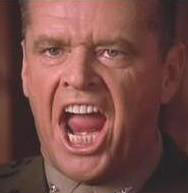
After seeing the play A Few Good Men so long ago, as it was interpreted by my peers in high school—it suited our all-male student body well—I finally managed to see the film that was based on that play and popularized it. The occasion was an extended quotation of Colonel Nathan Jessep's extended diatribe by a fellow seminarian, marvellously rendered in true Nicholson style. It was a stirring reminder of the play I'd seen over a decade ago, refreshing old memories of the same speech that had managed to be stirring even in the hands of a high school performer, to his credit.

I have never seen Nicholson in a movie where I was not captivated by his character. For me, as an actor he can do no wrong; whatever part he plays, I am transfixed. He fills the frame to the exclusion of all other characters. At every cut of the camera I await the inevitable barbs of caustic, raspy disdain, my delight increasing with each as they come. It is vanity, pure vanity, but he’s just so good at it…

Apart from Nicholson, I was disappointed in the film for a couple of reasons. At the risk of overanalyzing a 90s courtroom drama, and of saying many things that have been repeated many times over, there are a few things worth putting out there about how I experienced it. The most significant is that I didn’t side with the characters I was supposed to. Perhaps my undue attachment to the Colonel blinded me to the most central flaws of the “code” that was skewered so mercilessly, but I don’t think so. In the end I found the Marine rhetoric compelling, and when Kaffrey slaps the “sonofabitch” across his face it was totally unsatisfying—in part because it's never appealing to grind the loser under your heel, but mostly because what the Colonel says is in some sense true. Moreover, there is no development in Kaffrey’s character. There is no deeper awareness of the human, moral dimension of his work; his decision to go ahead and risk baiting Jessep to confess to ordering the Code Red is not driven by any desire to lay himself down in service of the truth or even in service to the men who depend on him for their legal defense. In the end, it is pragmatism and the conviction that he can succeed, nothing more. Risks were calculated and the numbers that fell against him were not unsurmountable. This is not a character that has matured in any way beyond a discovery of a proficiency of which he was not aware before and that he was afraid might not exist; we first meet him in a position that enabled him to "stay out of the courtroom" and thereby stick to what was reliable and safe. All that his changed is that he is more willing to be bold.

The cheesy synthesizer music that resolved into a nice major chord as soon as Kaffrey announces he will be putting Jessep on the stand after an off-screen soul-search for the “strength within” didn’t help, either. These sorts of moments were repeatedly being pushed aside by a bad soundtrack. This is what we call ham-fisted. I was naïve to expect more, but as a certain FT recently said, it’s nice to be treated like you’re smart enough not to be told outright what is going on in a story. And good grief, were 80s and 90s soundtracks really that bad? Who put up with this stuff? Sic transit gloria...

What the film did achieve was the tension between the two worlds of the abstract, legal realm and the situations in which the decisions made on high must be carried out. It is the age-old clash between the politician and the soldier (or, as Plato put it, between the ruler and the guardian); the worldview of each is so conditioned by its goals that the two constantly run up against one another. It just so happens that in this particular story the setting of the action is in the abstract world of the law, and not in the concrete setting the laws are meant to govern; it should come as no surprise that the lawyer comes out on top. He does, and that’s probably the way it should be. But the fact is, there is such a thing as a good Marine, and there is such a thing as a good lawyer, or manager, or lawmaker, and these are very different things. The soldier does what he must do and does it as best he can; regardless of what he is asked to do, there is a sort of excellence that can be achieved proper to himself. Likewise for the lawyer. Put a soldier in a courtroom and the lawyer will dance all over him; put a lawyer on the front and he will have his own lessons to learn. Take a soldier out of the field and subject his actions to rigorous scrutiny and there will be some glaring inconsistencies that, when articulated, will be as bewildering for the soldier as they are outrageous to the lawyer. This is a clash of worlds, and it is unavoidable. Wars will never be waged in orderly fashion.

That being said, I don’t want to give the impression the perjury of military officers should be condoned; the “bad guys” did wrong and they deserved to be punished. However, it was clear that the bad guys stood for something much more than military excellence run amok. Though the Marines were acquitted of their crimes, the source of meaning for their lives had been ripped out from beneath them, ostensibly to their benefit. The accidental death of a Marine resulting from a straightforward but unregulated act of peer correction was an unfortunate consequence of their devotion to a code of conduct, but that code informed and structured the lives of those young men in a way they could not do themselves. The conclusion of the film betrayed an antipathy for such communal structures of meaning and purpose, likening it to the flashy marches and rifle drills that began the film—eye-catching and impressive, but ultimately just the rehearsed and well-executed maneuvers of men required to concentrate only on not falling out of line with the soldier on either side in the hopes of creating a corporate body that acts in concert to the ultimate detriment of its members. This antipathy is just the sort of reaction a highly individualized perspective would have to such a structure, and this is the prevailing wisdom of our world today.

It was this repugnance to communal structures that fired my dislike for the film overall. Would I watch it again? I probably will, one day. It will take a few more viewings to get a good handle on Nicholson’s speech.