As I was sitting in the adoration chapel today before morning Mass, an old fella stepped in shuffled over to my bench. He is an inveterate talker, holding conversations and offering smalltalk in the sacred space of the chapel, clearly marked by signs and by nearly universal custom as a place of silence. I inwardly groaned when I saw his unmistakable gait out of the corner of my eye, certain that given my placement in the chapel there would be a conversation coming my way very soon. He appeared to think he would not be able to squeeze by me given how far my feet stuck out in front of my legs (they are big), and he thought a good way to get me to move them would be to comment on how big my feet are.
"What are those, size fourteen, fifteen?"
"Thirteen"
"So they are, yes. Big feet, they are."
"..."
After a minute or two of hoarse whispering on his part and tightlipped rejoinders on mine, he shuffled on by. I was relieved ... sometimes these little chats can stretch on for five or seven minutes, as I'm too polite to just tell him to shut his yap. But before taking his seat he leaned down close and said,
"My boy's got some big feet, too. You know what he tells people when they give him a hard time about his big feet?"
"What's that"
"He says, 'It takes a bigger foundation to build a church than a shithouse.' Don't you forget that, now."
No sir, I won't.

04 April 2009


26 March 2009
What Part of "I Don't Need Your Condoms" Don't You Understand?
Soviet agronomist Trofim Lysenko caught the attention of politicians and socialists alike with his bold rejection of Mendelian genetics in favor of theories of heightened production through "deep plowing" and unscientific planting tactics. In the early decades of communism, his theories were heralded as the path to abundance among the newly instituted farming communes, and the failures of these strategies were only acknowledged with ever more astounding propaganda claims for their success. Party ideologues found his theories amenable to their own strategies for industrialization, and so data that indicated they could not live up to their promises was ignored. Lysenko's theories were mandated as essential to the totalitarian aims of communism, and the losses in production are widely acknowledged as a signifcant reason why the USSR lost the cold war.
If you thought blind ideology was extinct, just peruse this little tidbit (via Zenit). A group of journalists from the West traveled to a HIV-care center in Uganda to see on the ground the conditions of this devastated region of Africa. If it wasn't so sad, it would be funny:
... But you'd be underestimating the power of ideology.
Read the whole thing here.
There's also a series of videos and commentary on the controversy here.
If you thought blind ideology was extinct, just peruse this little tidbit (via Zenit). A group of journalists from the West traveled to a HIV-care center in Uganda to see on the ground the conditions of this devastated region of Africa. If it wasn't so sad, it would be funny:
Seeing the condition of the HIV-positive women, they were moved. They decided to make themselves useful and do something for the women: they gave them a small box of condoms.The only thing more saddening than the inability of the West to surrender its ideological prejudices over the true nature of the problem is the hopelessness and suffering of the people themselves. You would think that a continent decimated by this incurable disease would be capable of drawing us out of our latex-sheathed ivory tower ...
Seeing this, the director reported, one of the women at the center, Jovine, looked at them and said: "My husband is dying and I have six children who will soon be orphans. What use are these boxes you are giving me?"
Many who talk about using condoms in Africa do so without the slightest knowledge of the problem and the conditions of the continent.
Because of this, the director observed, the Pope's statements caused little controversy in Africa itself.
'The Pope,' Busingye emphasized, 'is doing nothing else but defending and supporting precisely that which will be useful for helping these people: affirming the meaning of life and the dignity of the human being.'
... But you'd be underestimating the power of ideology.
Read the whole thing here.
There's also a series of videos and commentary on the controversy here.
24 March 2009
Letter to the Students
This is the letter I sent to the sixteen high school students that spent their spring break serving the people struck by the Greensburg Tornado last year.
Well, it’s Sunday afternoon and I saw a few of you at Mass this morning, and so I’ve decided to sit down and write you all a little something. My hope is to give it to each of you Monday afternoon, but perhaps some of you won’t be there, so this might have found its way into your hands some other way.
__________________
Well, it’s Sunday afternoon and I saw a few of you at Mass this morning, and so I’ve decided to sit down and write you all a little something. My hope is to give it to each of you Monday afternoon, but perhaps some of you won’t be there, so this might have found its way into your hands some other way.
What an emptiness I have felt since coming back from our trip! There is no way we could have sustained the pace of what we were doing for much longer, but isn’t it strange how I wish it hadn’t ended? Our bodies are too weak and fragile to do what we want them to, but still the desire for more is always there. Knowing what a difficult day Saturday would have been, I think I might have worked until I fell down in my tracks to hold off that day as long as I could.
Perhaps you have experienced the polite smiles and nods of those who couldn’t possibly understand the beauty of that week, no matter how many stories you tell or how enthusiastically you tell them. No doubt you’ve already asked yourself if it’s worth it to even try …. and it is, even if what we say cannot communicate the fullness and the breadth of that experience. As we struggle and fail to articulate our thoughts and feelings, however, we may come across someone else who has done what we thought impossible. This is the great pleasure of literature, and since our return, I’ve come back again and again to a book I read my first year in seminary entitled The Brothers Karamazov, by Fyodor Dostoyevsky. It is one of the classics of literature and I hope that you will all get the chance to read it one day—slowly, for pleasure and edification, rather than racing through it for some lit class that you need to graduate. Dostoyevsky put into words what I could not, and I wanted to pass along the words that captured so well for me the spirit of our time together.

The story ends with the death of a young boy named Ilyusha who was once the outcast of his group of friends on account of his poor, weak, foolish father. Through the slow process of dying, the other boys (probably right around Noah and Naomi’s age) begin to recognize what a noble and generous soul their schoolmate was, who felt his father’s humiliation keenly and responded with fury to the taunts the boys of the town would make at his father. Their grief over the loss of their friend was intensified by his passing so soon after they came to love him. After his death, one of the Karamazov brothers, by the name of Alyosha, a young man preparing to leave and enter the monastery, speaks to them near a stone outside their village (and so this speech has been named “the speech at the stone”). It is addressed to the young boys who befriended Ilyusha, but it could just as well be addressed to each of you, young women and men alike, who spent their break in service to a pair of Ilyushas and their parents:
Gentlemen, we shall be parting soon … I shall leave this town, perhaps for a very long time. And so we shall part, gentlemen. Let us agree here, by Ilyusha’s stone, that we will never forget—first, Ilyusha, and second, one another. And whatever may happen to us later in life, even if we do not meet for twenty years afterwards, let us always remember how we buried the poor boy, whom we once threw stones at—remember, there by the little bridge?—and whom afterwards we all came to love so much. He was a nice boy, a kind and brave boy, he felt honor and his father’s bitter offense made him rise up. And so, first of all, let us remember him, gentlemen, all our lives. And even though we may be involved with the most important affairs, achieve distinction or fall into some great misfortune—all the same, let us never forget how good we once felt here, all together, united by such good and kind feelings as made us, too, for the time that we loved the poor boy, perhaps better than we actually are … My dear children, perhaps you will not understand what I am going to say to you, because I often speak very incomprehensibly, but still you will remember and some day agree with my words. You must know that there is nothing higher, or stronger, or sounder, or more useful afterwards in life, than some good memory, especially a memory from childhood. You hear a lot said about your education, yet some such beautiful, sacred memory, preserved from childhood, is perhaps the best education. If a man stores up many such memories to take into life, then he is saved for his whole life. And even ifAgain and again the word that rises up in the peaceful moments of recollection is “dignity”. This is what you all came to understand better than you ever have before—the dignity of the needy persists despite their own inability or unwillingness to act in accordance with it. It is a dignity that demands to be acknowledged. Yet there was another discovery—a dignity that you can now call your own. The great John Paul II said that we only discover ourselves in the authentic gift of ourselves. Think back on the consolations you experienced once you “pressed through” your initial frustration and disgust and got down to the dirty work of actually doing something to help. That was a taste of the joy that comes with an authentic gift of self, and that is something that we can experience each and every moment of our lives. That is Christ’s promise to us. Take him up on it.only one good memory remains with us in our hearts, that alone may serve some day for our salvation. Perhaps we will even become wicked later on, will even be unable to resist a bad action, will laugh at people’s tears and at those who say, ‘I want to suffer for all people’—perhaps we will scoff wickedly at such people. And yet, no matter how wicked we may be—and God preserve us from it—as soon as we remember how we buried Ilyusha, how we loved him in his last days, and how we’ve been talking just now, so much as friends, so together, by this stone, the most cruel and jeering man among us, if we should become so, will still not dare laugh within himself at how kind and good he was at this present moment!

Last April, I went to New York to visit the Pope when he came to America, and he had some stirring words for the youth. He referred to the prayer for the light to overcome the world’s darkness—a prayer that echoes the opening words of John’s Gospel, and that is prayed each Easter vigil (which is coming up for us in a few short weeks!). He asked,
What might that darkness be? What happens when people, especially the most vulnerable, encounter a clenched fist of repression or manipulation rather than a hand of hope? It pertains to the heart. Here, the dreams and longings that young people pursue can so easily be shattered or destroyed. I am thinking of those affected by drug and substance abuse, homelessness and poverty, racism, violence, and degradation—especially of girls and women. While the causes of these problems are complex, all have in common a poisoned attitude of mind which results in people being treated as mere objects—a callousness of heart takes hold which first ignores, then ridicules, the God-given dignity of every human being. Such tragedies also point to what might have been, and what could be, if other hands—your hands—reached out. I encourage you to invite others, especially the vulnerable and the innocent, to join you along the way of goodness and hope.
I think that now we all have a better idea of what it means to make that invitation.
Finally, there is no one right way to react to the sights and sounds of those two houses in Bucklin. Some process their reactions by putting them in plain view, holding nothing back; others need to retreat into the “inner chamber” and work through things in solitude in the days and weeks that follow. Sometimes we can be put off or disappointed by the sort of response we see in others to what did or did not move us individually. Let it unfold as it will, and don’t force yourself to conform to expectations. Be attentive to your own graces so that you can more readily recognize them in others.
So, let’s not forget that family, and let’s not forget one another! Thanks for the week that made me, for the time I was with you, better than I am.
In Christ our Brother,
NICK.

07 March 2009
The Desk Chair Review of Books, continued
The Christian State of Life
by Father Hans Urs von Balthasar
May I please begin this review by saying that The Christian State of Life should be required reading for every vocation director, director of seminarians, and spiritual director involved in helping others to discern God's call. I say this not because it offers practical advice on making the choice (there are plenty of perspectives on this already) but because of the grand, sweeping vision of the whole of Christian life that it presents. It might be called a work of "vocational theology," if such a term existed, one which is deeply immersed in the Scriptures (especially the Gospels) and the unique re-presentation of the longstanding mystical tradition presented by St. Ignatius of Loyola in his Spiritual Exercises. If the subject is of interest to you in the least, I would get ahold of a copy from the library (they're hard to find right now, as Ignatius Press is apparently between printing s) and read the first sixty and the last forty pages. If they whet your appetite, start again from the beginning and take notes as you go—it's helpful for keeping track of where he is in the overall structure of the work.
Balthasar begins with a treatment of "love in the abstract," a long catalogue of the qualities of love as it is in itself and not as human persons are capable of it. The author reveals himself here as a disciple of the mystics, most especially Bernard. The pages read like a gloss on Bernard's sermon on love, in which he writes,
Love is sufficient of itself, it gives pleasure by itself and because of itself. It is its own merit, its own reward. Love looks for no cause outside itself, no effect beyond itself. Its profit lies in its practice. I love because I love, I love that I may love.
Balthasar is infused with the same intoxicating fervor of the immensity of love, and he takes utterly seriously the commandment to love the Lord with all one's mind, heart, and strength. One has the sense here of being in touch with the Love that is the source of all things, and it's hard not to be drawn into such contemplative intensity. This passage constitutes a real examination of conscience for the reader, and certain phrases ring out with clarity many weeks later: "Love does not ask what must be done, but what can be done; the first is not a question that love asks."
The states in life are rooted in God's original call for humanity to be in relationship with him through loving obedience, generous poverty, and fecund purity. This is the state of our first parents. Balthasar treats the "original state" with the sort of naivete (if one can call it that) of a practiced exegete who has come full circle to the text once again by way of the many insights of scholarship; he approaches Scripture with a refreshing straightforwardness that unlocks the secrets of Scripture not as a critical examiner but a disciple. With this method, he dives into the Scriptural accounts of the creation and fall in order to shed light on the redemption and the Church as the continuation of Christ's mission.
 Balthasar then examines minutely Christ's own "state of life" and that of his mother in order to demonstrate how the present possibilities for the Christian life are rooted in their one "stand" in the Father's will. These sections draw on Balthasar's Trinitarian and Christological theology, subjects few of us have the knowledge to master, but they nonetheless place the life of discipleship firmly within the context of the Trinitarian life and the whole economy of salvation. (This subject was the material for my term paper, one of the most difficult and rewarding papers I've written so far, and I would be glad to share it with anyone who's interested in looking more closely at the subject.)
After a lengthy examination of the states of election and the secular state (i.e. the state of the vows and the ordinary "lay" state) and their relationship to one another, Balthasar takes a close look at the ministerial priesthood and where it fits within this whole economy. I can say very little about this, as my research forced me to put my time in elsewhere, but suffice to say I will be returning to it in the very near future to explore his insights. What is most intriguing is what he does with the concept of priestly service as one of representation and sacrifice; it reaches its perfection, of course, in Christ, but for the reason that here priest and victim are one. Balthasar concludes from this that the most perfect sacrifice (and therefore the sacrifice Jesus himself offered) is the one in which one surrenders even the consciousness of love in the performance of it; everything one does, then, becomes the impartial performance of a purely formal, external act. Some of his most stirring words are to be found in this section (though I may be partial to the subject). Particularly notable is the justification for the Church's authority, which Balthasar perceives to be constituted by the very unworthiness of those who exercise it:
No human way of life is ever totally adequate to the greatness of the divine mission conferred with the priestly office. For how can any human person be worthy to impart the word 0f God? How can he be permitted to dispense the grace of God, to say in the name of God's Son: 'This is my body' or 'Your sins are forgiven you', to bind and loose in such a manner that his action is ratified in heaven? Only the consciousness of an incurable unworthiness that reaches to the very depths of his being can be the halting response to the call to such a ministry. This is true even if the one so called strives in duty and in gratitude to let his whole being be re-formed in accordance with the ministry bestowed on him by God himself. This mark of absolute imparity between person and office is the beginning and end of the Church's authority. It helps him who is charged with the office to bear it and him who must obey it to look beyond the person and even the weakness of the minister to the divine character of what he administers.
The final section of the book is a treatment of the nature of the "call" itself, its recognition, and the possibility to reject or accept it in freedom. Other commentators, based on a more precise reading of Balthasar than my own, would quality some of his harsh language regarding the need to follow one's vocation; I defer to that judgment as a whole, with the qualification that such incentives (exaggerated as they may be) are necessary for a generation of Catholics largely ambivalent to the question of radical discipleship. The lack of commitment to forms of religious life and the ministerial priesthood—and even to the married state—would suggest that among the many other factors that undermine readiness to "follow the Lamb wherever he goes", the lack of insistence by our pastors that vocational discernment is a necessity for every single Christian is one of the most disheartening. The last fifteen pages of Christian State of Life will certainly make you take a serious look at your own discernment!
19 February 2009
Touch Up
I'd never been aware of how powerful photo editing software could be.
I invested in a copy of Adobe Photoshop Elements back in December and only recently started going through old photographs. The ones I'd taken with my old Pentax K-1000 (a film camera made in the '60s) had been digitally scanned, but I'd never played with them much. Here are a few examples of what Elements was able to do:
 After
After
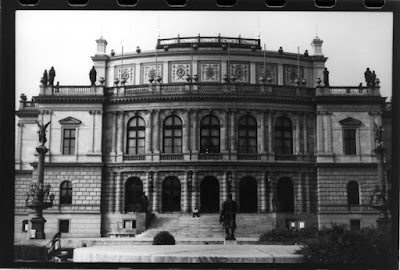
 After
After

 After
After
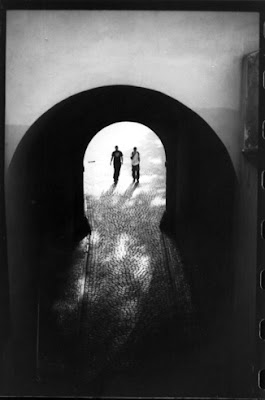
I invested in a copy of Adobe Photoshop Elements back in December and only recently started going through old photographs. The ones I'd taken with my old Pentax K-1000 (a film camera made in the '60s) had been digitally scanned, but I'd never played with them much. Here are a few examples of what Elements was able to do:
Before
 After
After
Before
 After
After
Before
 After
After
18 February 2009
[Insert Sardonic Reference to Houses Built on Sand HERE]
From the NY Times today:
But now, in Dubai, they sit around smoking and drinking coffee. The whole thing reminds me of some kind of Karamazovian self-destructive profligacy.
.
"Before, so many of us were living a good life here,” Mr. Thiab said. “Now we cannot pay our loans. We are all just sleeping, smoking, drinking coffee and having headaches because of the situation."I worked with a bunch of kids from the UAE in the summer of 2001 as a counselor at a summer camp. They were here in the US to learn to fly planes (note the pre-9/11 date) as cadets in their Air Force, and ranged from 14-19 years old. They were paid ungodly amounts of money and spent it on all sorts of frivolous things, and bragged about how their president paid every family in the country thousands of dollars and showered them with expensive gifts, built nice roads so these seventeen year olds could race their Maseratis, and so forth. (It was nice for the counselors--I remember how most of the stuff got left behind because they couldn't take it on the plane. I still have a couple of their prayer rugs and a dishdasha.) Their fathers were unlettered tribesmen who suddenly found themselves swimming in wealth without having any clue about how to put it to good use; much of the real estate boom in Dubai was a channel for their income that would have some lasting benefits to the country rather than perpetuating the financial equivalent of pouring water out on sand (as was the custom ever since oil was discovered there in the early sixtes). Many predicted a nosedive after the oil ran out, but diversification in their economy promoted stability and made the UAE economy one of the fastest growing in the world.
But now, in Dubai, they sit around smoking and drinking coffee. The whole thing reminds me of some kind of Karamazovian self-destructive profligacy.
.
17 February 2009
For Catholic Eyes Only
Given the explosion of coverage on matters papal these past few weeks, one can hardly wonder about how our unique situation has come about. As the Body of Christ, the Church is to radiate holiness to the world, restore humanity to grace, and speak of God despite her own very real imperfections on the way to the omega of history. Yet it seems like all anybody is interested in are the sort of housekeeping details that are only necessary for the faithful themselves to attend to. What other social body gets its dirty laundry aired as much as the Church does? The Williamson debacle was a PR blunder that was exacerbated by what appear to be incendiary remarks on the part of a divisive and extremist figure. I suppose the uproar was justified on some level, but heads of state composing letters of protest? Does anyone really think the pope is interested in denying the Holocaust?
A professor here (who happens to be a priest of a diocese in Germany) has made a number of comments to the effect that what is happening over in Europe in response to some of these events (the latest being the attempt to appoint Father Gerhard Wagner to the episcopal see of Linz) is much more a political issue than a religious one. Accusations of rebellion are flying fast and hard over the Austrian bishops' response to the appointment and the SSPX reconciliation, among other things. I am utterly baffled as to what is really going on, especially given Cardinal Schonborn's record as editor of the Catechism and his years as Ratzinger's student.
Something smells iffy. . . does anyone know something the rest of the world doesn't? (Or won't?)
.
A professor here (who happens to be a priest of a diocese in Germany) has made a number of comments to the effect that what is happening over in Europe in response to some of these events (the latest being the attempt to appoint Father Gerhard Wagner to the episcopal see of Linz) is much more a political issue than a religious one. Accusations of rebellion are flying fast and hard over the Austrian bishops' response to the appointment and the SSPX reconciliation, among other things. I am utterly baffled as to what is really going on, especially given Cardinal Schonborn's record as editor of the Catechism and his years as Ratzinger's student.
Something smells iffy. . . does anyone know something the rest of the world doesn't? (Or won't?)
.
15 February 2009
Sometimes, People Are Just Wrong
When people ask for feedback, tell them what you really think. Affirmation without criticism is insulting. It implies either an inattentiveness to what has actually been done, a judgment that the one who has humbled himself to receive help is incapable of improving, or flagrant disgregard for the good of your fellow human being.
All are sins against Christian charity. So quit it.
.
All are sins against Christian charity. So quit it.
.
11 February 2009
They're Still To Be Found
Finally, a capable spokesman steps forward to represent the perspective of faith. Recently, Boston College (a Jesuit university) put crucifixes in all 151 of its classroms which had up to that point been devoid of any religious imagery.
Read the whole article here:
http://www.insidehighered.com/news/2009/02/11/bostoncollege
.
I don't know about you, but I find that remarkably well said.The process was described by some as gradual, but one faculty member deemed it a “tsunami” of religious art that appeared in classrooms over winter break. And while most discussions on this matter have been private, opinions seem to run the gamut.
In a statement provided through Dunn [the PR manager for the university], Rev. T. Frank Kennedy, chair of the committee on Christian Art, wrote: “I suppose a question might be posed to Boston College as to what purpose this Christian Art serves? In a world that is pretty successfully driven by media (imagery), ours is a response that seeks to pose the age-old invitation of Christ to enter into love--a love that is made perfect in its unselfishness. John Paul II spoke of the crucifix on September 15, 2002 saying ‘It is the sign of God, who has compassion on us, who accepts human weakness, who opens to us all, to one another, and therefore creates the relation of fraternity.’ The Pope also went on to say that though this symbol has been abused in history, it is the Christian’s duty to reclaim that symbol as an invitation to love. An invitation to love, and an invitation to faith is exactly that, an invitation. One is not required to respond, one can decline, and one can have many reasons for declining the invitation, but to imply that a Jesuit and Catholic university is not free to offer this invitation is simply an impossibility.”
Read the whole article here:
http://www.insidehighered.com/news/2009/02/11/bostoncollege
.
09 February 2009
Catholic Schools Week
Thanks to the students and teachers of Prince of Peace Catholic School in Olathe and Mrs. Meyer's 4th grade class at Xavier Catholic School in Leavenworth for their care packages and notes of encouragement! There were some really thoughtful cards. My favorite, though, asked if "I had always wanted to be a priest, or whether I'd ever wanted to be something".
It's great to get a show of support from the kids in the Catholic schools. Keep up the good work, and be thankful that we aren't facing the same troubles as the Catholic Schools in Washington, D.C.
It's great to get a show of support from the kids in the Catholic schools. Keep up the good work, and be thankful that we aren't facing the same troubles as the Catholic Schools in Washington, D.C.
02 February 2009
Answering Other People’s Mail
It's been a while since I've put together a sustained piece, and a recent series of moral theology classes have coincided with a long exchange in First Things over the issue of contraception, so I figgered this was as good a time as any to dive in.
If you're not familiar with Mary Eberstadt's essay in the July issue, The Vindication of Humanae Vitae, I would suggest printing it out and making your way through it. Those of you not in the habit of reading while obeying certain biological imperatives to eliminate digestive waste can consider this a personal invitation to start.
What caught my attention about this exchange was a paragraph from letter that showed up in the January issue. It raises a very reasonable question that I've encountered before. The question centers around the situation in which a couple wishes to remain faithful to the Church's teaching, and so chooses to avoid pregnancy by abstaining from sex during the wife's fertile period (the method used in NFP). The Church permits this for "grave reasons".
People of good will might then ask what exactly the difference is between artificially regulating births and using so-called "natural" methods to achieve the same end—avoiding pregnancy. The author of the letter asks,
It would seem logical that couples having intercourse [only] in the wife's infertile period are intending to prevent conception—otherwise what could be their motive? "Family planning" and "spacing of children," if legitimate ends, require careful calculations of the female menstrual cycle and avoidance of marital relations at certain times. Though the end does not justify the means, the distinction between "natural" and "artificial" contraception loses force in actual practice.
In essence, the question is: what the heck is the difference, you Jesuitical hairsplitter? Only having sex during a wife's infertile period seems just as susceptible to the objection that a couple is refusing to be "open to life".
And of course, that possibility has to be granted. A married couple abstaining from sex for the sole purpose of avoiding children fails to preserve the connection between the unitive and procreative dimensions of married sex, and commits an error similar to a couple using contraception.
So what is the solution? The letter goes on,
The Catechism of the Catholic Church seems to send a mixed message: "Each and every marriage act must remain open to the transmission of life," and "every action which . . . proposes, whether as an end or as a means, to render procreation impossible is intrinsically evil." Is the solution that Catholic couples may have marital intercourse only during the fertile period?
Well what have we here? A warmed-over medieval physicalism? "No kids? Then NO SEX FOR YOU!" Obviously this solution goes too far—the Church holds up marital intercourse as a legitimate good even between spouses who, in the unfolding of nature, cannot have children.
In her reply, Eberstadt is right to draw attention to the word "impossible" in the Catechism: no one using NFP wishes to render procreation impossible, whereas that is the express intention of anyone using chemical means to alter the woman's biology in such a way as to prevent even the possibility of conception (i.e. ovulation) from arising.
Our solution must lie elsewhere. I suggest that a look at Karol Wojtyla's examination of these questions in Love and Responsibility may be of assistance.
Wojtyla points out that placing contraception and NFP side-by-side as competing "methods", each of which has its relative advantages and disadvantages, is misleading from the start. If we are looking for the difference between these two using a framework of manipulation as our springboard, there will always be the possibility for an equivalence between the two. Wojtyla recasts the discussion in a wholly different context: the personalistic norm.
The personalistic norm is the demand that persons are the only creatures created for their own sake, and therefore are never to be used as a means. This is the content of Jesus' commands to "love your neighbor as yourself" and to "love one another as I have loved you". This norm is to be observed in all human relationships, but most especially between those who make the commitment to love another person in the context of marriage.
This norm excludes from marriage the mutual use for sexual pleasure, and Wojtyla points out that any decision on the part of a couple to have sex despite a refusal to have any children whatsoever would reduce the marriage covenant to a selfish arrangement for mutual sexual enjoyment (p. 239).
Acceptance of the possibility of procreation in the marital relationship safeguards love and is an indispensable condition of a truly personal union. The union of persons in love does not necessarily have to be realized by way of sexual relations. But when it does take this form the personalistic value of the sexual relationship cannot be assured without willingness for parenthood (p. 230).
OK, so we can rule that out. What about couples that are open to procreation in the future?
Wojtyla argues that periodic continence—that is, occasionally refraining from sex during fertile periods—is the only way couples can keep their relationship in line with the personalistic norm. This is because engaging in periodic continence is only possible through the achievement of a certain level of the virtue of chastity.
The personalistic value of periodic continence as a method of regulating conception is evident not only in the fact that it preserves the 'naturalness' of intercourse, but even more in the fact that in the wills of the persons concerned it must be grounded in a sufficiently mature virtue. (p . 241)
Far from being a negative "turning away" from sex, chastity is the full "yes" to the whole person, including the body with its physical attractiveness, but not limited to it. One cannot imagine an unmarried couple accustomed to casual intercourse giving full assent to even their bodies (which include their fertility). Only a married couple can exercise the virtue of chastity in their sexual relationship, because only spouses have made a permanent, total commitment to one another in the sum of their personhood and have accepted the wholeness of that mutual gift with joy.
Wojtyla goes on to say that,
Continence, unless it is a virtue, is alien to love. The love of man and woman must ripen to the point where continence is possible, and continence must acquire a constructive significance for them, and become one of the factors which gives shape to their love. Only then is the 'natural method' congruent with the nature of the person: its secret lies in the practice of virtue—technique alone is no solution here (p. 242)
It follows, then, that taking a long view of a marriage, periodic continence can only be used to regulate conceptions and not to avoid them. That is, it is undertaken with a view in mind to subsequent pregnancies that are part and parcel of the fruitfulness of the love they share. Interestingly enough, the language Wojtyla uses implies that this is a decision that can be made only after they have already had one or more children. It is not just the good of the spouses that must be considered, but that of the "family"; due responsibility for the birth, care, and education of a child must be weighed in contemplating the possibility of "another" pregnancy. The implicit claim is that couples have no real right to be regulating births prior to their responsibility for their present child(ren).
I remember a conversation I had with a girlfriend over this issue. I thought it was perfectly reasonable for a couple to hold off having kids for a few years to work on their marriage, get their ducks in a row, etc. and found a few articles and quotes that seemed to back up my point. We went back and forth for a while over it. Yet there was one conversation I will not forget: she simply said that if a couple wasn't ready to have kids, they had no business being married. This was no idle speculation for her, either—she was third in a family of ten, and had spent a good portion of her adolescence and young adulthood helping to raise her younger brothers and sisters (an experience she valued immensely).
In the end, I have enough married friends who are struggling to have children (including one that has lost four little ones to miscarriage) that I've become acquainted with the particular form of anguish the cross of infertility can bring. I can't imagine it's any lighter than the difficulties of raising a little one or three (especially when reckoned alongside the real consolations a young family brings). That, of course, is not to mention my own situation as one who has forsaken a family for the sake of the kingdom. Thus, I have little patience for the extenuating arguments of those who have decided that kids just aren't part of the picture yet.
Of course, in addressing this issue, I've got to let go of that impatience and become, in the words of Paul VI, "an echo of the voice and love of the Redeemer." So often, I've heard defenses of the Church's teaching on contraception spiral into a shrill litmus test for orthodoxy, rather than a life-giving discipline that opens up new horizons in a marriage. Small wonder people aren't interested in hearing more about it. Though I hesitate to dive into the subject on a blog where I don't have any responsibilty to follow up with people (as opposed to the pulpit), it's important for me to have the chance to propose this teaching rather than impose it.
In the closing paragraphs of Humanae Vitae, Paul VI issued an appeal to all walks of life to step forward prophetically and proclaim the generosity of the Father in linking the gift of procreation to conjugal love. In particular, he encouraged married couples with the hope that the practice of this teaching confers on their love a higher human value; that, "thanks to its beneficent influence, husband and wife can fully develop their personalities and be enriched with spiritual values."
It should be a reason for all of us to rejoice that the Lord has entrusted to spouses the task of "making visible to all the holiness and sweetness of the law which unites the mutual love of husband and wife with their cooperation with the love of God, the author of human life."
31 January 2009
Former NASA Climatology Chief Puts the Chill on Global Warming
I realize my posts have been more news-related lately, which is definitely not where I plan to continue going with this blog, but there has been some juicy stuff of late that just screams to be shared.
The latest is a public rebuke of James Hansen, the NASA scientist first responsible for breaking the man-made climate change scenario to Congress in 1988, by Dr. John Theon, his former supervisor. Hansen has been very radical and very vocal in his advocacy, but some inconvenient developments have begun to swing the prevailing winds in another direction.
The latest is a public rebuke of James Hansen, the NASA scientist first responsible for breaking the man-made climate change scenario to Congress in 1988, by Dr. John Theon, his former supervisor. Hansen has been very radical and very vocal in his advocacy, but some inconvenient developments have begun to swing the prevailing winds in another direction.
“I appreciate the opportunity to add my name to those who disagree that global warming is man made,” Theon wrote to the Minority Office at the Environment and Public Works Committee on January 15, 2009. “I was, in effect, Hansen’s supervisor because I had to justify his funding, allocate his resources, and evaluate his results.”Hansen was a noted authority in Gore's acclaimed film, "An Inconvenient Truth."
...
Theon declared “climate models are useless.” “My own belief concerning anthropogenic climate change is that the models do not realistically simulate the climate system because there are many very important sub-grid scale processes that the models either replicate poorly or completely omit,” Theon explained. “Furthermore, some scientists have manipulated the observed data to justify their model results. In doing so, they neither explain what they have modified in the observations, nor explain how they did it. They have resisted making their work transparent so that it can be replicated independently by other scientists. This is clearly contrary to how science should be done. Thus there is no rational justification for using climate model forecasts to determine public policy,” he added.
Gore faces a much different scientific climate in 2009 than the one he faced in 2006 when his film was released. According to satellite data, the Earth has cooled since Gore’s film was released, Antarctic sea ice extent has grown to record levels, sea level rise has slowed, ocean temperatures have failed to warm, and more and more scientists have publicly declared their dissent from man-made climate fears as peer-reviewed studies continue to man-made counter warming fears.Read all this and more over at Watts Up With That.
Subscribe to:
Posts (Atom)